Rechercher dans ce blog

Tuesday, September 20, 2022

Nvidia announces RTX 40-series graphics cards with DLSS 3 and 2-4x performance boost - GSMArena.com news - GSMArena.com

Nvidia today announced three new graphics cards based on its next generation graphics architecture. Available starting next month, the prices for these will start at $899.
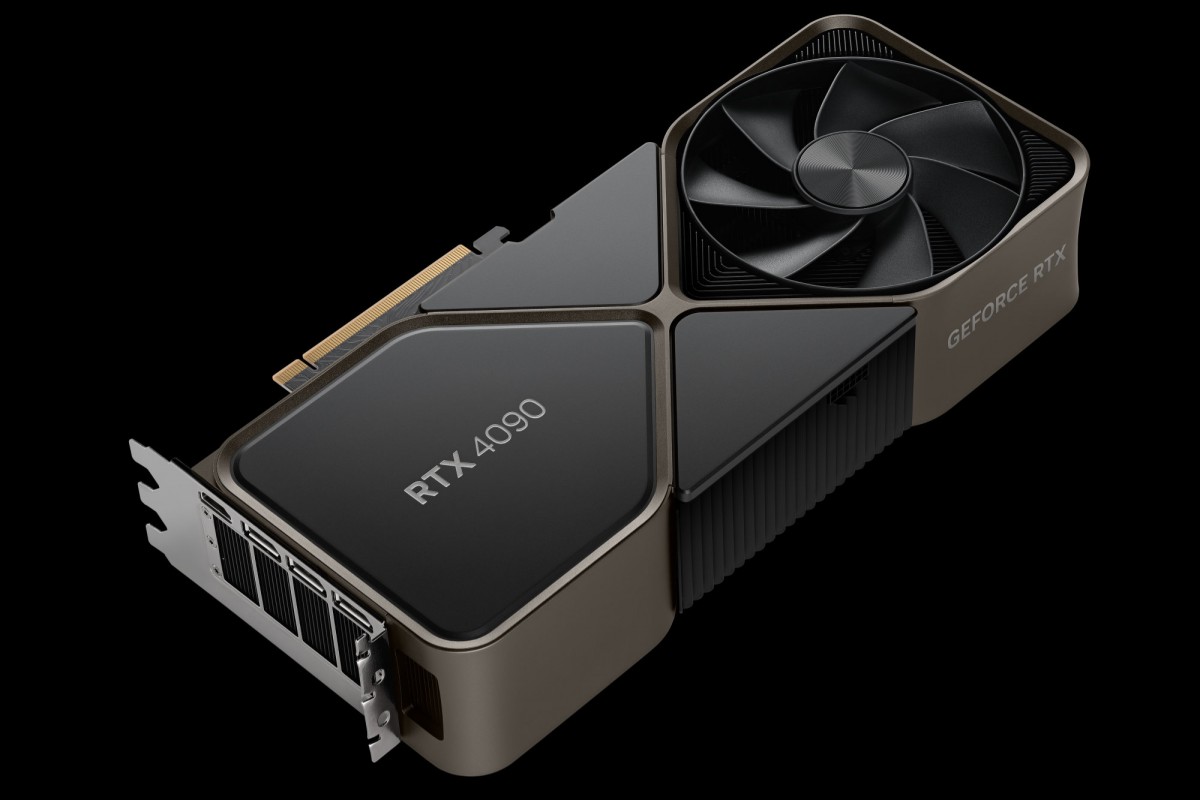
Nvidia announces RTX 40-series graphics cards with 2-4x performance and DLSS 3

At the top of the stack is the new RTX 4090. This massive new GPU features 16384 CUDA cores with boost clocks that go up to 2.52GHz. The card comes with 24GB of GDDR6X memory and 384-bit memory interface. Nvidia claims it is 2-4x faster than the RTX 3090 Ti. The RTX 4090 has a power rating of 450W and runs on a single 16-pin PCIe Gen 5 or 3x 8-pin PCIe cables. It's priced at $1599 and will be available starting October 12.

Nvidia announces RTX 40-series graphics cards with 2-4x performance and DLSS 3

Next is the RTX 4080, which comes in two variants. The more premium variant features 9728 CUDA cores and 2.51GHz boost clock. It has 16GB GDDR6X memory with 256-bit interface. Nvidia claims it is 2-4x faster than the RTX 3080 Ti. Then there's also a second variant with 12GB GDDR6X memory and 192-bit memory interface. This version has 7680 CUDA cores and 2.61GHz boost clock.

The 16GB model has a power rating of 320W and the 12GB of 285W. They are priced at $1199 and $899, respectively and will be available in November.

Nvidia announces RTX 40-series graphics cards with 2-4x performance and DLSS 3

At the heart of these new graphics cards is the new GPU. Based on Nvidia's new TSMC 4nm Ada Lovelace architecture, the new GPU features 3rd generation RT cores, 4th generation Tensor Cores, and support for new features such as DLSS 3 and AV1 encoder.

Compared to the 40 shader-TFLOPs of the RTX 3090 Ti, the RTX 4090 has 83-TFLOPS. Thanks to the new Shader Execution Reordering, shader performance is claimed to improve by 2x and in-game frame rates by 25%. Nvidia also claims that the RT performance on the RTX 4090 is around 191-TFLOPS while the RTX 3090 Ti was capable of 78-TFLOPS. The new 4th generation Tensor cores are said to have 5x throughput on the RTX 4090.

Nvidia announces RTX 40-series graphics cards with 2-4x performance and DLSS 3

The 40-series cards will also feature two of the 8th generation Nvidia Encoders (NVENC). These can not only decode AV1 but will also be able to encode it. The company has partnered with OBS Studio to bring AV1 encoding to its client. Nvidia has also bumped the ShadowPlay capture resolution to up to 8K at 60fps in HDR.

Nvidia announces RTX 40-series graphics cards with 2-4x performance and DLSS 3

One of the more impactful features announced was DLSS 3, which will be exclusive to 40-series graphics cards. The new version uses an Optical Flow Accelerator and data from sequential frames to create new frames on the GPU itself (rather than within the game) to improve frame rates by up to 4x. This method also bypasses any CPU bottlenecks that affect traditional upsampling and image reconstruction methods as the frame rate increases.

Nvidia announces RTX 40-series graphics cards with 2-4x performance and DLSS 3

Over 35 games have been announced with support for this feature, including Cyberpunk 2077 and Microsoft Flight Simulator. These will start appearing next month. The company also announced a version of Portal with real-time ray tracing, which will be launching in November and be a free update to existing Portal owners. It's part of the Nvidia RTX Remix modding platform, which features tools for improving the visuals of older titles.

Getting back to the graphics cards, the new 40-series models will replace the 3090 series of cards but will join the existing 3060, 3070, and 3080 series of cards, which will continue to be sold. We do not expect lower end 40-series models until 2023.

Nvidia announces RTX 40-series graphics cards with 2-4x performance and DLSS 3

Nvidia will be selling its own Founders Edition cards for the RTX 4090 and the 16GB RTX 4080, alongside models from AIB partners, such as ASUS, Colorful, Gainward, Galaxy, GIGABYTE, INNO3D, MSI, Palit, PNY, and ZOTAC. Most of these cards feature a 3-4 slot design along with beefy power requirements. The cards will have HDMI 2.1 and DisplayPort 1.4a connectivity.

Source

Adblock test (Why?)


Nvidia announces RTX 40-series graphics cards with DLSS 3 and 2-4x performance boost - GSMArena.com news - GSMArena.com
Read More

Apple iPhone 14 durability test leaves its mark on the Sapphire crystal camera lens cover as the device proves incredibly sturdy - Notebookcheck.net

JerryRigEverything on YouTube, Teaser Image: Apple, Tima Miroshnichenko on Pexel-edited

Adblock test (Why?)


Apple iPhone 14 durability test leaves its mark on the Sapphire crystal camera lens cover as the device proves incredibly sturdy - Notebookcheck.net
Read More

Sunday, September 18, 2022

Forget hardware, Google wants user data, Pixelbook laptops to Pixel phone notwithstanding - HT Tech

Yes, Google does make hardware and we have seen them in the form of Pixelbook, Pixel phones or even Chromebooks, but hardware is just not central to the big profit picture that Google is actually painting. For Google, it is not the gadgets that are important, it is the user data and for that its software is doing a fine job even as other hardware companies do the hard work or making and selling their products on which Goggle software is riding. They are also taking the risk of making products that may or may not sell, but that is something that Google does not need to worry about.

What Google is doing making hardware is to test the waters with its software and perhaps even gently prod manufacturers down pathways that they should go. Then Google sits back and collects the user data that flows through its software on other companies' hardware- phones to computers and more.

Providing an example is Android Central. Take for instance what happened to Pixelbook. Google simply cancelled the line! Now, the fans of the product were much displeased, but as far as Google was concerned it all made perfect sense. After showing other companies the product' capabilities, Google withdrew and other companies, which manufacture laptops, took over.

In that respect, Google resembles Microsoft rather than Apple simply because it creates software for other people to put in their products while the latter builds products and also tailors software for them.

Yes, both Google and Microsoft also manufacture products as was mentioned earlier, but the intent is entirely different. Google makes products in order to test and improve its software to the greatest extent possible. Through these products Google tries out "specialised hardware configurations", as Android Central said, to improve its other businesses. That is why Google has a long list of products it makes including cameras, wi-fi routers and more.

The end result is ultimately always a desire to collect more and more users data even though it may well be losing money on these hardware products. And user data is where Google actually makes its money.

"I think that their final aim may be the information of users obtained through the device use rather than generating revenue through device sales itself," said Sujeong Lim, research analyst at Counterpoint Research.

In effect, it is a win-win situation for all involved, from companies to the users themselves- as long as they don't find their privacy being exploited.

And this strategy is likely to be deployed in the Pixel Watch too. Once the other smartwatch manufacturers pick up and run with similar products, Google is likely to step back once the target is achieved. and if the product fails, it simply stops making them.

One thing is clear though, if Google was able to get everything it wants from other companies' hardware, it would most probably not be in the manufacturing business at all. Since it cannot, it has to do it.

So, killing off its hardware for Google is just part and parcel of the business that goes to fatten its profits.

Adblock test (Why?)


Forget hardware, Google wants user data, Pixelbook laptops to Pixel phone notwithstanding - HT Tech
Read More

Saturday, September 17, 2022

Tecno Pop 6 Pro goes official with a 6.6" screen and 5,000 mAh battery - GSMArena.com news - GSMArena.com

Tecno announced the Pop 5 Pro in January, and eight months later, it unveiled the Pop 6 Pro.

The Tecno Pop 6 Pro is built around a 6.6" HD+ screen with a notch for the 5MP selfie camera, which has a flash on its left side to help you take brighter pictures in dim lighting conditions. The smartphone's rear panel has a textured finish and sports two cameras - an 8MP primary unit joined by what's likely a depth sensor.

Tecno Pop 6 Pro goes official with a 6.6'' screen and 5,000 mAh battery

The Pop 6 Pro is powered by an unknown quad-core processor and comes with 2GB RAM and 32GB of storage onboard. It boots HiOS 8.6 based on Android 12 (Go Edition) and packs a 5,000 mAh battery - that's 1,000 mAh smaller than the Pop 5 Pro's cell. The 4G smartphone also features a side-mounted fingerprint scanner for biometric authentication.

Tecno Pop 6 Pro goes official with a 6.6'' screen and 5,000 mAh battery

The Tecno Pop 6 Pro comes in two colors - Peaceful Blue and Polar Black. The smartphone is listed on Tecno's official Bangladeshi website, but its pricing is unknown.

Tecno Pop 6 Pro Tecno Pop 6 Pro
Tecno Pop 6 Pro's color options

That said, the Pop 6 Pro will launch soon in India since the company's Indian branch has started teasing the smartphone. However, the brand is advertising the smartphone with a 6.56" screen. Chances are that's what the actual diagonal of the Pop 6 Pro's panel is, and Tecno's Bangladeshi division decided to round it off to 6.6".

Source

Adblock test (Why?)


Tecno Pop 6 Pro goes official with a 6.6" screen and 5,000 mAh battery - GSMArena.com news - GSMArena.com
Read More

Friday, September 16, 2022

Blinkit starts home delivery of iPhone 14 and other Apple Products - Times Now

Realme GT Neo 3T finally comes to India - GSMArena.com news - GSMArena.com

Realme's GT Neo series is not a new thing for the Indian market, but it took some time for Realme to start shipping its Neo 3T smartphone. Today, the Indian branch announced on Weibo that it will kick off sales on September 23.

Realme GT Neo 3T finally comes to India

The handset features a Snapdragon 870 SoC, 120Hz OLED display and 80W SuperDart charging. We have a whole written review of the Neo 3T so make sure you check that out before taking out your credit card.

Realme's own web store and Flipkart will be selling the device in three memory options - 6GB/128GB. 8GB/128GB and 8GB/256GB costing INR 29,999, INR 31,999 and INR 33,999, respectively. Sales kick off at 12PM local time on September 23.

Source

Adblock test (Why?)


Realme GT Neo 3T finally comes to India - GSMArena.com news - GSMArena.com
Read More

Motorola Razr 40 And Razr 40 Ultra Are Cheaper By Up To Rs 20,000 In India - Times Now

Motorola Razr 40, Razr 40 Ultra Prices Slashed in India; Foldable Phones Now Start at Rs. 44,999 Motorola has announced an attr...